
Common Law Claim Payouts NSW

Written by
Principal Lawyer and Director · Last updated 31 August 2026
4.9 from 265+ verified Google reviews Read all reviews
Key Takeaway: A work-related psychological injury in NSW may entitle you to weekly payments, medical expenses and a lump sum. You need at least 15% whole person impairment to qualify, and the maximum payable for permanent impairment in NSW is $637,290.
Psychological Injury Compensation: Quick Answers
Work health and safety laws in NSW protect workers who suffer physical injuries and psychological injuries at work. Whether you have sustained a back injury, a broken bone, a musculoskeletal condition, or a psychological injury such as anxiety, depression or PTSD, you may be entitled to mental health workers compensation benefits and a common law claim payout in NSW.
The workers compensation system in New South Wales covers both physical and psychological work injuries. Primary psychological injuries caused by employment are included in the NSW workers compensation system while secondary psychological/psychiatric problems emerging as a result of another work injury are treated differently. If you suffered a work injury, you may be entitled to a compensation benefit, including a common law payout:
Lump Sum Payment for Psychological Injury

If you’ve sustained a work-related psychological or psychiatric injury, you may be entitled to various forms of compensation, including weekly payments, medical expenses, and a lump sum payment for permanent impairment. These entitlements are part of the workers’ compensation scheme in NSW, designed to support individuals who suffer injuries or illnesses due to their employment.
To qualify for a lump sum payment for a psychological injury in NSW, specific criteria must be met:
Permanent Impairment Assessment
Your condition must be assessed by an accredited medical professional to determine the degree of Whole Person Impairment (WPI), evaluating how much your psychological injury affects your overall ability to function.
Minimum Threshold
To be eligible for a lump sum payment, your psychological injury must result in a permanent impairment of 15% WPI or greater. Conditions assessed below this threshold will not qualify.
Primary Psychological Injury
The injury must be classified as a primary psychological condition directly caused by your work. Secondary psychological conditions arising from a physical injury are not eligible for lump sum payments.
Common Law Claims for Psychological Injury NSW
Common law claims for psychological injury allow you to receive your future loss of earnings until the age of retirement by way of a lump sum payment. In NSW, the maximum payable amount for permanent impairment is $637,290. That amount is for permanent impairment and does not include an amount for future loss of earnings.
If your injuries are assessed at 15% whole person impairment or greater and the injuries were because of your employer’s negligence, you may be able to make a common law claim for your psychological injury in NSW. Receiving a payout by way of a common law claim means that you will not be receiving any kind of compensation benefits through your workers compensation claim upon settlement.
Workers Compensation Payouts for Psychological Injury
| Occupation | Number of claims | Average claim payment | Average weeks off work |
|---|---|---|---|
| Army personnel, fire fighters, police | 690 | $65,200 | 46 |
| School teachers | 640 | $23,100 | 12 |
| Health support workers | 460 | $20,100 | 14 |
| Bus and rail drivers | 400 | $4,200 | 2 |
| Personal carers and assistant | 340 | $12,000 | 10 |
| General clerks | 310 | $24,800 | 15 |
| Nursing and midwifery professionals | 300 | $18,400 | 11 |
| Salespersons and sales assistants | 260 | $13,400 | 14 |
| Administrative workers | 250 | $35,900 | 20 |
| Social and welfare professionals | 230 | $24,000 | 18 |
| All occupations (including above and others) | 7820 | $23,600 | 15 |
According to Safe Work Australia’s Mental Disorders Report, the average workers compensation payout for psychological injuries is $23,600. The average time off work amongst psychological injury claimants is 15 weeks. Psychological injuries account for 6% of all workers compensation claims.
How to Make a Successful Claim
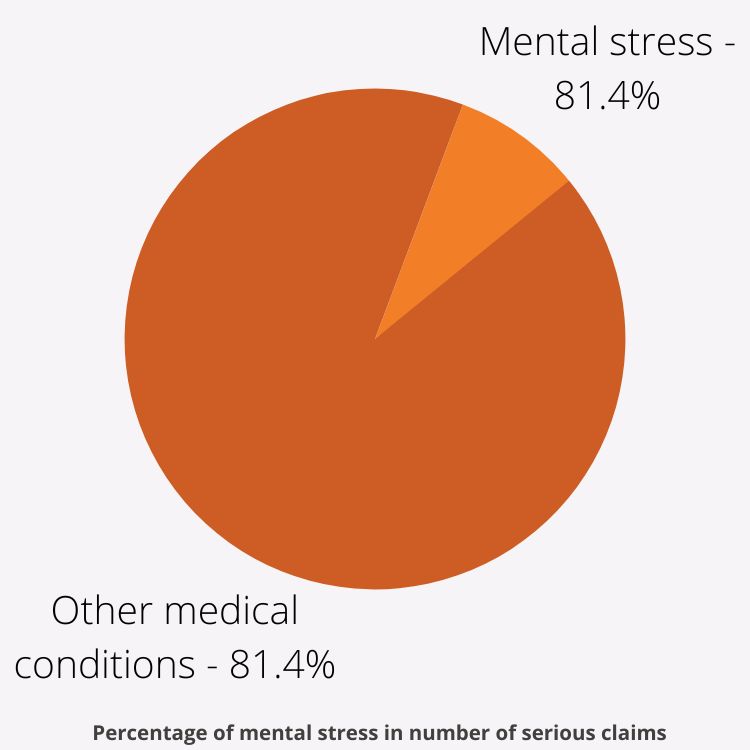
Both physical and psychological injuries fall under the Workers Compensation Act 1987 (NSW). As soon as you are aware of your situation, contact your employer and notify them. Make sure you have sufficient medical proof of your injury — you should be able to get a “Certificate of Capacity” from your doctor. Afterwards, fill out and submit a Work Injury Claim form to your employer or the insurer.
Psychological Injury Due to Bullying and Harassment

Most common work-related psychological injury claims emanate from toxic work environments where employees become subject to workplace bullying, assaults, sexual harassment, and workplace conflicts.
SafeWork Australia actively works on taking appropriate measures for introducing effective mechanisms to ease psychological injury compensation claims management on the part of employers.
Bullying and harassment experienced at work can lead to psychological injury as well as problems like stress, anxiety and reduced work capacity. Bullying can be defined as systematic offence, humiliation or intimidation through gossip, social exclusion, aggressive behaviour, sexual harassment, or cyber-bullying.
It can result in negative consequences on a bullied person’s mental health by creating distress and low self-confidence which may eventually give way to psychological injury from a legal point of view.
If you believe you are a victim of bullying in your workplace, take necessary steps such as reporting it to your manager — even if you are not suffering from a mental illness because of it. It is important to report the bullying in writing as you may require evidence later.
Immediate action can help protect your mental well-being in the long run. It could also be used against you that you did not report the bullying to the employer.
Why Should I Hire a Psychological Injury Lawyer?

You can benefit from consulting a psychological injury lawyer at any stage of your workers compensation claim. Our psychological injury lawyers can help you correctly identify your situation, break down the claim making process, let you know about your rights, and act on your behalf. Our workers compensation lawyers will also offer critical guidance if your claim is rejected by insurers or employers.
Common Law Claim Payouts NSW FAQs
Is work-related stress covered by workers compensation?
Work-related stress may significantly affect an employee’s mental well-being. Although stress does not qualify as an injury in NSW by itself, the aggravation of it due to an employer’s negligence may result in psychological injury. Claiming compensation for this type of injury requires medical proof and evidence.
How long after a work injury can I claim compensation?
Workers compensation claims should be made within 6 months after the date that you are aware of the injury. In some situations such as absence from the state, a claim can be made up to three years. Contact our workers compensation lawyers to advise you on your specific situation.
When should I speak to a work injury lawyer?
If you sustained an injury due to employment, you can consult our workers compensation lawyers at any point in your claim process. It is important to see our workers compensation lawyers as soon as possible to ensure you are receiving all of your entitlements, and also if the insurer has denied your claim.
Do I have to be in Sydney to make an injury compensation claim?
You do not have to be in Sydney to make a compensation claim if you sustained a work-related injury. Regardless of where you are located in NSW, the law and process is the same. Our workers compensation lawyers are conveniently located in Sydney, Parramatta, Penrith, Liverpool and Wollongong.
How much compensation can I get from an injury claim?
The benefits you may obtain will depend on the specific circumstances of your case, including the seriousness of your injury and your whole person impairment rating. A lump sum for permanent impairment in NSW can reach a maximum of $637,290. Consulting our workers compensation lawyers can help you anticipate the best results of your claim.
Do I have to pay legal costs for my injury claim?
You do not have to pay our workers compensation lawyers for legal costs and disbursements. The Workers Compensation Independent Review Office (WIRO) pays for our legal costs and disbursements to advise you and act on your behalf. This means you can pursue your psychological injury claim without the burden of upfront legal fees.
Which jobs have the highest proportion of making injury claims?
Some occupations are more prone to psychological injury, including defence force members, police officers, firefighters, health and welfare support workers, school teachers, bus drivers, rail drivers, and emergency nurses. These roles often involve high stress, trauma exposure or demanding conditions that can lead to anxiety, depression or PTSD claims.
What is the difference between a primary and secondary psychological injury?
A primary psychological injury is a mental health condition, such as anxiety, depression or PTSD, caused directly by your employment. A secondary psychological injury develops as a result of another work injury, such as a physical injury. Only primary psychological injuries are eligible for a lump sum permanent impairment payment in NSW.
About the author
Issa Rabaya · Principal Lawyer and Director
✓ Admitted to the Supreme Court of NSW and High Court of Australia ✓ LLB ✓ IRO-approved ✓ Law Society of NSW
Acts for injured people in CTP, workers compensation, TPD and public liability claims.
Why Choose Withstand Lawyers for Your Psychological Injury Claim?
A psychological injury can affect every part of your life, from your ability to work to your relationships and sense of self. We understand how overwhelming it feels to face a claim while you are still unwell, so we handle the legal side with care and keep the process as simple as possible. Our team guides you through the whole person impairment assessment, gathers the medical evidence your claim needs, and fights for the full lump sum and benefits you are entitled to. You will always know where your claim stands and what happens next. Over $60 million recovered, 99% success rate, no win, no fee.
Call Withstand Lawyers on 1800 952 898 for your free claim check today.
“Working with Esther has been an absolute blessing during an incredibly difficult time. Anyone who has ever had to navigate an insurance claim knows just how difficult, overwhelming, and anxiety-inducing the entire process can be. Before reaching out to Withstand Lawyers, I was constantly stressed and deeply overwhelmed by the system. The firm made the initial intake process incredibly smooth, and they placed me in the hands of my lawyer, Esther. From that moment on, from the first conversation, I finally found my solid ground. Esther has completely transformed how I navigate this unfortunate situation. Because she handles my matter directly, I have a direct line of contact with her and never have to jump through hoops to get support. Esther’s presence alone has given me immense confidence in my claim. What sets her apart is her perfect balance of professional mastery and genuine empathy. As a client, having a lawyer who truly listens and supports you when your mind is filled with doubt is a massive relief. She doesn’t just manage a file — she consistently protects her client’s peace of mind. Her recommendations are always highly logical, realistic, and clear-cut. She cuts through the legal confusion and tells you exactly where you stand, which is exactly what you need during the hardest times of your life. I feel incredibly lucky to have Esther and her team at Withstand Lawyers by my side. For anyone out there facing a difficult time with an insurer and looking for a legal advocate who offers absolute clarity, strength, and compassion — I cannot recommend Esther highly enough. She is a truly admirable professional who genuinely cares about the people she protects. Truly grateful!” “I have searched top lawyers (personal injury) in Sydney. I found Withstand Lawyers so I rang them up and asked I need lawyers that are nicer and more understanding despite what I am going through. They exceeded my expectations especially Issa, he always remind everyone to be more cautious when speaking to me and I really appreciate that. I am satisfied that my case (MVA) turned out to be successful. Withstand lawyers is more than 5 stars. Can’t recommend highly enough.” “I would like to express my deepest appreciation for the incredible support I’ve received over the past 4.5 years. My case has been long, complicated, and filled with challenges, but Issa and his team stood by me through every step with genuine care, professionalism, and dedication. Their compassion has meant just as much to me as their legal expertise. They didn’t just handle my case, they helped me through some of the most difficult years of my life. I wholeheartedly recommend them to anyone who needs genuine support, honesty, and a team that truly cares about your wellbeing.” “Thank you Withstand Lawyer for your exceptional work, professionalism and easy process for successfully assisting me with my TPD claim. I am thankful for your support. I highly recommend Withstand Lawyers and the services they provide.” “Had a very positive experience with Withstand Lawyers. The team was professional, knowledgeable, and supportive throughout the entire process. They took the time to explain everything clearly, kept me informed at every stage, and responded promptly to my questions. Their attention to detail and commitment to achieving the best possible outcome gave me confidence from start to finish. I truly appreciate their dedication and excellent service, and I would highly recommend Withstand Lawyers to anyone looking for reliable and trustworthy service.” Issa Rabaya Director, Lawyer Founder and Director with 12 years' experience since his 2014 admission, previously at the largest litigation law firm in Australia. A personal injury lawyer for serious injuries, leading Withstand Lawyers' work across every claim type, with settlements reaching into the millions, including a $6.3 million motor vehicle accident result. Esther Ihn Senior Associate Senior Associate with over a decade of experience exclusively in personal injury claims since 2014, handling hundreds of matters across motor vehicle accidents, workers compensation, work injury damages and public liability. The team's go-to for serious-injury claims. Minaa Mohmand Special Counsel Special Counsel with over a decade of experience since 2016, handling complex, higher-value claims: serious injuries, disputed liability and matters heading to litigation, across motor vehicle accidents, work injury damages, public liability and TPD. Mihana Wen Associate Associate with 6 years' experience since 2020 and a recent $1.95 million motor vehicle accident settlement, known for not taking no for an answer and lodging appeal submissions for injuries insurers try to deem below the 11% whole person impairment threshold for pain and suffering. The go-to for car accident claims, guiding clients from the first CTP submission through to settlement with a compassionate, hands-on approach. Isabel Sarcia Senior Lawyer Lawyer with 6 years' experience since 2020, working exclusively in TPD and superannuation claims, necessary because these claims turn on strict super fund definitions and procedure that few generalist lawyers see day to day. Specialises in lodging TPD claims efficiently, cutting through fund delays so claims are accepted faster and in full. Maria Drosos Associate Lawyer with 6 years' experience since 2020, working exclusively in TPD and superannuation claims, necessary because these claims turn on precise policy wording and medical evidence that few generalist lawyers handle daily. Specialises in lodging TPD claims efficiently, managing the insurer requests and medical reports that decide the outcome. Chenoa Ingram Lawyer · 4+ yrs experience Lawyer with 4+ years' hands-on experience in personal injury claims, built inside the firm before her 2026 admission, known for being organised and efficient in progressing clients' workers compensation, work injury damages, public liability and TPD claims. Lauren Bergan Lawyer · 4+ yrs experience4.9 ★ — 265+ Reviews
Meet Your Lawyers