
Work Injury Damages Claim Calculator

Written by
Principal Lawyer and Director · Last updated 14 September 2026
4.9 from 265+ verified Google reviews Read all reviews
Key takeaway: A work injury damages claim is calculated by multiplying your future weekly economic loss by a statutory multiplier. For example, a 45 year old earning $1,400 per week with 20 working years left could have a base calculation above $1.6 million, though realistic settlements often land between $200,000 and $400,000.
Work Injury Damages Claim Calculator: Quick Answers
If you’ve been seriously injured at work, you are likely dealing with much more than just the physical pain. There’s the stress of mounting medical bills, the uncertainty of not being able to earn an income, and the overwhelming feeling of not knowing what your future holds.
You probably know about the weekly payments and medical coverage that come with a standard workers’ compensation claim. What many don’t realise is that if your injury was caused by your employer’s fault, you might be entitled to a separate and significant lump sum payment. This raises the critical question: what is my work injury claim worth?
A work injury damages claim calculator helps to estimate this second, less common path. It’s not a magic tool that spits out a guaranteed number. Instead, think of it as a guide designed to give you a clearer picture of the potential value of this separate, fault-based claim.
This guide demystifies these two different types of workplace injury claims. It breaks down what a work injury damages claim is, what factors are considered when calculating a settlement, and what it all means for you after a workplace injury.

What Is a Work Injury Damages Claim?
Many injured workers don’t realise there are two separate types of claims.
Workers compensation is designed to provide weekly payments and cover medical expenses after a workplace injury. It helps with immediate support after an accident, but it doesn’t account for your full future financial loss.
For injured workers who are permanently affected, workers compensation alone may not be enough to compensate them for the financial losses they are suffering. This is where a work injury damages settlement comes in.
A work injury damages claim is a separate claim made against your employer (through their insurer) for cases where their negligence contributed to your injury. Instead of weekly payments, it aims to compensate you in a lump sum for your long-term financial loss. Not just the income you have missed out on, but for all future earning potential you have lost as a result of your injury.
Put simply:
-
Workers compensation = short-term financial support
-
Work injury damages claim = compensation for long-term loss
If your injury has permanently reduced your ability to work, a work injury damages claim may be what truly protects your financial future.
And that’s why understanding how your settlement is calculated is so important.
How Is a Work Injury Damages Claim Calculated?
A work injury damages claim is calculated by looking at what you were earning before the injury, what you would likely have earned in the future, how many working years you had left until retirement, and the superannuation you would have accumulated along the way. That future income is then adjusted using a statutory multiplier to convert it into a present-day lump sum. Let’s simplify that.
Step 1: What Were You Earning?
This is your baseline.
If you were earning $1,400 per week at the time of injury, that’s the starting point.
But we don’t stop there.
Step 2: What Would You Have Earned?
This is where many people undervalue their claim.
We look at everything that would have impacted your earnings:
- Expected promotions
- Industry growth
- Planned business ventures
- Overtime history
- Career trajectory
Your claim isn’t frozen in time. It reflects your future.
Step 3: The Multiplier
Because a work injury damages claim is paid as a lump sum, the court applies a multiplier to convert years of lost income into a present-day figure.
That multiplier reflects how many working years you had left until retirement, adjusts for life’s uncertainties and contingencies, and discounts the amount to today’s value.
Lawyers rely on actuarial tables to do this properly.
It’s a structured legal calculation, not guesswork. Let’s look at an example:
Work Injury Damages Calculation – Example
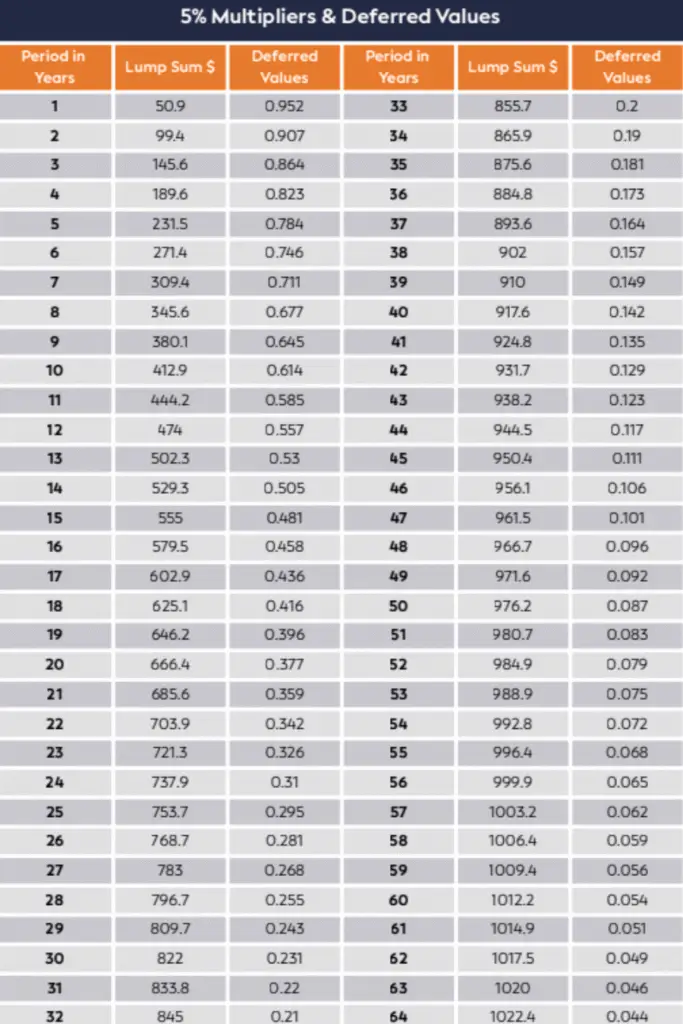
Let’s say you were earning $1,400 per week as a warehouse worker at the time of your injury, but by 2028 you were expecting to be promoted as a warehouse manager, earning $2,000 per week. You’re 45 years old and planned to work until 65, giving you 20 years of remaining employment. Based on actuarial tables (below), the multiplier applied to those 20 years would be 666.4.
Here’s how the calculation works:
- Short-term future loss:
$1,400 × 99.4 = $139,160
Superannuation at 12.5% = $17,395
Total short-term future loss = $156,555 - Long-term future loss:
$2,000 × 666.4 = $1,332,800
Superannuation at 14.6% = $194,588.80
Total long-term future loss = $1,527,388.80
Together, your short term and long term future loss set the base calculation for your claim. But here’s what matters:
That number is not automatically what you receive.
It’s the ceiling.
Not the guarantee.
How Much Can You Claim for Work Injury Damages Payouts?
The maximum payout is usually “the full amount you would have earned if you were never injured”. But real-world settlements depend on risk.
Courts and insurers consider:
-
How strong negligence evidence is
-
Whether your employer breached safety obligations
-
Your residual work capacity
-
Transferable skills
-
Medical evidence
-
Likelihood of future employment
Example Work Injury Damage Settlement Range
If your maximum calculation is $1,600,000, but:
-
You have office-based transferable skills
-
Medical evidence doesn’t support total incapacity
-
You can still work in some capacity
Your realistic settlement range may fall between:
$200,000 to $400,000
That’s common in many NSW WID claims, and every case is different.
Want to know what your work injury damage payout could be worth? Contact our work injury damages lawyers today for a free claim assessment.

What Is a Typical Work Injury Damages Settlement Worth?
It’s a a common question: “What is a typical work injury damages settlement worth?”
Unfortunately, there is no “average” payout figure that can be given that fits everyone.
Every work injury damages claim in NSW turns on its own facts. Settlement value depends on your age, your pre-injury income, the severity of your injury, the strength of the negligence evidence against your employer, and whether you retain any ongoing work capacity. These variables shape both the maximum theoretical claim and the realistic negotiation range.
How Do I Maximise the Calculation on My Work Injury Damages Claim?
The strength of your work injury damages claim is determined by your evidence.
If you have documents, keep them. Payslips, contracts, emails about promotions, incident reports, photos of the worksite, messages to supervisors. They all can matter more than you think. Small details often become decisive later.
Your lawyer’s role is to build on that foundation. In most work injury damages claims, independent expert evidence is obtained. If you were injured on a construction site due to faulty formwork, for example, an experienced builder, formworker or safety inspector may be asked to prepare a report. Not someone connected to your employer. Someone independent. Someone with experience in this field.
That expert doesn’t just quote regulations. They explain what should have happened, what a safe system of work required, what was foreseeable, and how your employer could have prevented the injury. They draw on industry standards and years of hands-on experience. When done properly, that report clearly outlines where the system failed, and why you shouldn’t carry the financial consequences of that failure.
Maximising your claim isn’t about exaggeration. It’s about clarity. It’s about proving what was lost and why it happened.
And the stronger the evidence, the stronger your position.
Do You Need a Lawyer to Calculate Your Work Injury Damages Claim?
No, you don’t legally need a lawyer to calculate your work injury damages claim. But there’s a difference between doing a rough estimate and properly valuing your financial future.
A lawyer who regularly handles work injury damages claims understands what evidence is required, how multipliers are applied, how superannuation is calculated, and how to factor in risk. They know where claims are commonly undervalued and how insurers assess earning capacity. That experience can significantly affect the final outcome.
Most work injury damages lawyers operate on a no win, no fee basis, although terms and conditions vary between firms. At Withstand Lawyers, we operate on a clear no win, no fee arrangement and provide upfront clarity about what our fees will be for your specific claim. Our legal costs are only payable upon successful completion of your matter and are deducted from your settlement, so you’re not out of pocket while your case is running.
When your future income is on the line, careful calculation isn’t a luxury. It’s protection.

Free Claim Check With Our Work Injury Damages Lawyers
Our senior lawyers have helped thousands of people in NSW, and we are ready to help with your claim. Call us on 1800 952 898 or book a consultation to meet our lawyers in any location in NSW for a free claim check.
Work Injury Damages Claim FAQs
How is a work injury damages claim calculated in NSW?
What is a typical work injury damages settlement worth?
How accurate is a work injury damages claim calculator?
What is the difference between workers compensation and a work injury damages claim?
What multiplier is used to calculate work injury damages payouts?
Is superannuation included in a work injury damages claim calculation?
What evidence strengthens a work injury damages claim?
Do I need a lawyer to calculate my work injury damages claim?
About the author
Issa Rabaya · Principal Lawyer and Director
✓ Admitted to the Supreme Court of NSW and High Court of Australia ✓ LLB ✓ IRO-approved ✓ Law Society of NSW
Acts for injured people in CTP, workers compensation, TPD and public liability claims.
Why Choose Withstand Lawyers for Your Work Injury Damages Claim?
When a serious workplace injury threatens your income and your future, the team beside you matters. Withstand Lawyers has helped seriously injured workers across NSW for decades, recovering more than $60 million for clients and maintaining a 99% success rate. Withstand Lawyers runs every work injury damages claim on a no win no fee basis, so you pay nothing upfront and nothing at all unless your claim succeeds. From gathering payslips and independent expert reports to negotiating with the insurer, Withstand Lawyers treats your claim with the care your recovery deserves, keeping you informed at every step.
Call 1800 952 898 for a free claim check. No win, no fee, no upfront costs.
“Working with Esther has been an absolute blessing during an incredibly difficult time. Anyone who has ever had to navigate an insurance claim knows just how difficult, overwhelming, and anxiety-inducing the entire process can be. Before reaching out to Withstand Lawyers, I was constantly stressed and deeply overwhelmed by the system. The firm made the initial intake process incredibly smooth, and they placed me in the hands of my lawyer, Esther. From that moment on, from the first conversation, I finally found my solid ground. Esther has completely transformed how I navigate this unfortunate situation. Because she handles my matter directly, I have a direct line of contact with her and never have to jump through hoops to get support. Esther’s presence alone has given me immense confidence in my claim. What sets her apart is her perfect balance of professional mastery and genuine empathy. As a client, having a lawyer who truly listens and supports you when your mind is filled with doubt is a massive relief. She doesn’t just manage a file — she consistently protects her client’s peace of mind. Her recommendations are always highly logical, realistic, and clear-cut. She cuts through the legal confusion and tells you exactly where you stand, which is exactly what you need during the hardest times of your life. I feel incredibly lucky to have Esther and her team at Withstand Lawyers by my side. For anyone out there facing a difficult time with an insurer and looking for a legal advocate who offers absolute clarity, strength, and compassion — I cannot recommend Esther highly enough. She is a truly admirable professional who genuinely cares about the people she protects. Truly grateful!” “I have searched top lawyers (personal injury) in Sydney. I found Withstand Lawyers so I rang them up and asked I need lawyers that are nicer and more understanding despite what I am going through. They exceeded my expectations especially Issa, he always remind everyone to be more cautious when speaking to me and I really appreciate that. I am satisfied that my case (MVA) turned out to be successful. Withstand lawyers is more than 5 stars. Can’t recommend highly enough.” “I would like to express my deepest appreciation for the incredible support I’ve received over the past 4.5 years. My case has been long, complicated, and filled with challenges, but Issa and his team stood by me through every step with genuine care, professionalism, and dedication. Their compassion has meant just as much to me as their legal expertise. They didn’t just handle my case, they helped me through some of the most difficult years of my life. I wholeheartedly recommend them to anyone who needs genuine support, honesty, and a team that truly cares about your wellbeing.” “Thank you Withstand Lawyer for your exceptional work, professionalism and easy process for successfully assisting me with my TPD claim. I am thankful for your support. I highly recommend Withstand Lawyers and the services they provide.” “Had a very positive experience with Withstand Lawyers. The team was professional, knowledgeable, and supportive throughout the entire process. They took the time to explain everything clearly, kept me informed at every stage, and responded promptly to my questions. Their attention to detail and commitment to achieving the best possible outcome gave me confidence from start to finish. I truly appreciate their dedication and excellent service, and I would highly recommend Withstand Lawyers to anyone looking for reliable and trustworthy service.” Every work injury damages claim is handled by a personal injury lawyer with dedicated work injury damages experience. Issa Rabaya Director, Lawyer Founder and Director with 12 years' experience since his 2014 admission, previously at the largest litigation law firm in Australia. A personal injury lawyer for serious injuries, leading Withstand Lawyers' work across every claim type, with settlements reaching into the millions, including a $6.3 million motor vehicle accident result. Esther Ihn Senior Associate Senior Associate with over a decade of experience exclusively in personal injury claims since 2014, handling hundreds of matters across motor vehicle accidents, workers compensation, work injury damages and public liability. The team's go-to for serious-injury claims. Chenoa Ingram Lawyer · 4+ yrs experience Lawyer with 4+ years' hands-on experience in personal injury claims, built inside the firm before her 2026 admission, known for being organised and efficient in progressing clients' workers compensation, work injury damages, public liability and TPD claims. Minaa Mohmand Special Counsel Special Counsel with over a decade of experience since 2016, handling complex, higher-value claims: serious injuries, disputed liability and matters heading to litigation, across motor vehicle accidents, work injury damages, public liability and TPD. Lauren Bergan Lawyer · 4+ yrs experience4.9 ★ — 265+ Reviews
Meet Your Work Injury Damages Lawyers