
Are You Getting What You Are Supposed to From Your TPD claim?

Written by
Principal Lawyer and Director · Last updated 31 July 2026
4.9 from 220+ verified Google reviews Read all reviews
Key Takeaway: ASIC Report 633 found that of the 26,000 TPD claims made through superannuation funds, only 65% were accepted by insurers. If your total and permanent disability claim has been declined or underpaid, you may not be getting what you are supposed to, and it is worth having it reviewed.
TPD Claim: Quick Answers
Before looking at what consumers are getting out of their TPD insurance and the effectiveness of their policies, it is important to define Total and Permanent Disability (TPD) Insurance. TPD insurance is a specific type of insurance where a specific lump sum amount is paid to the insured (employee) if they become totally and permanently disabled under the terms of the insurance policy. ASIC Report 633 reviewed TPD insurance claims, and found that although 26,000 TPD claims were made through superannuation funds, only 65% of TPD claims were accepted by insurers.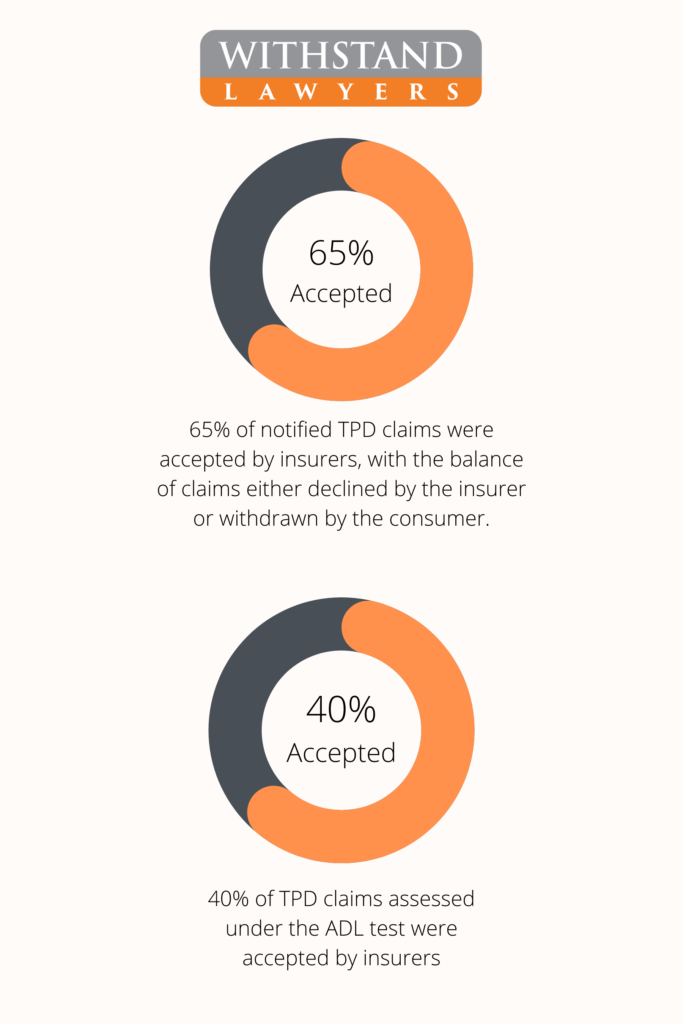 Significant findings in the realm of TPD insurance were made in this report, and this may be demonstrated by way of the fact that around three out of five (or 60%) of claims assessed under this narrow cover are declined- which is also five times higher than the average declined claim rate for all other TPD claims (12%). Further to this, where Insurers committed to inconsistent lodgement processes such as poor communication practices when it was time for TPD claims to be made, it more often prevented the claim from succeeding- and this is where our experienced TPD lawyers at Withstand Lawyers can assist you in obtaining the best result.

In addition, ASIC Report 675 draws attention to certain areas that Superannuation Trustees need to rapidly improve upon if Australians are to receive benefits from their TPD insurance policies. For example, the December 2020 report drew attention to two major concerns- the first being that: there is unfortunately wide variation in default cover offered- with some large MySuper products offered over 20 times as much default cover as the smaller ones. Also, the second and most resounding issue found by the Report was that certain trustees were unable to properly identify which members had default insurance. For this reason, if Superannuation Trustees in Australia are to fulfil their promise of offering good TPD insurance policies to their customers, then it is essential for them to abide by the Australian Prudential Regulation Authority’s Prudential Standard SPS 515 Strategic planning. It provides Trustees with a handy guide as to how to assess outcomes provided to members in insurance areas, and helps them to identify opportunities for improving these outcomes. Due to these difficulties faced with TPD insurance and in ensuring that the best outcome is achieved, our TPD lawyers at Withstand Lawyers are readily available to assist to resolve any queries or concerns you may have.

How can Withstand Lawyers help you?
At Withstand Lawyers we are committed to assisting you after what may be regarded as a tumultuous period in your life, after having sustained a life-changing injury or illness. Our No win No fee lawyer work on a No Win No Fee basis, which means that unless you receive a successful outcome by way of payment, you will not pay our costs and disbursements. Contact us if you have any concerns with your TPD policy, and our legal team will readily act on your behalf to ensure you receive the best possible TPD payout possible for your TPD claim.
TPD Claim FAQ
What is a TPD claim?
A total and permanent disability (TPD) claim is a lump sum benefit paid through your superannuation or an insurance policy when injury or illness stops you working in your usual occupation. ASIC Report 633 looked at 26,000 such claims made through super funds, so they are a common and significant entitlement worth pursuing.
How many TPD claims are actually accepted?
ASIC Report 633 found that of the 26,000 TPD claims made through superannuation funds, only 65% were accepted by insurers. That means a large number of claims were declined, and many of those refusals can be reviewed, because a decline does not always mean the claim was assessed correctly.
Why are claims under an activities of daily living definition declined so often?
Claims assessed under a narrow activities of daily living definition are declined at a much higher rate. ASIC Report 633 found around three out of five, or 60%, of these claims are declined, which is five times higher than the 12% average decline rate for all other TPD claims.
What should I do if my TPD claim was declined?
Do not assume a declined claim is final. With only 65% of the 26,000 super fund claims accepted, many valid claims are wrongly refused. Have the policy definition, the medical evidence and the insurer’s reasons reviewed, as each of these can be challenged where the assessment was unfair.
How do I know if I have been underpaid on my TPD claim?
Even accepted claims can be paid below their true value if the policy terms or your medical position were not fully considered. A review checks the definition applied, the evidence relied on, and whether the insurer met its obligations, so you can see whether you received what you were supposed to.
Does having a lawyer improve my chances with a TPD claim?
Insurers assess claims strictly, and the 60% decline rate under narrow cover shows how easily valid claims are refused. A lawyer reviews the definition, builds the medical evidence, and holds the insurer to account, which helps make sure your claim is assessed on its genuine merits rather than a technicality.
How long does a TPD claim take?
Timeframes vary depending on your fund, the insurer and the medical evidence required. Because ASIC Report 633 showed many claims are declined or delayed, getting the right evidence together early and responding promptly to the insurer helps keep your claim moving and reduces the risk of an avoidable refusal.
What does it cost to have my TPD claim reviewed?
Withstand Lawyers acts on a No Win No Fee basis, so you can have your total and permanent disability claim reviewed without upfront legal cost. Given only 65% of TPD claims are accepted, a review is a low-risk way to check whether your claim was properly assessed.
About the author
Issa Rabaya · Principal Lawyer and Director
✓ Admitted to the Supreme Court of NSW and High Court of Australia ✓ LLB ✓ IRO-approved ✓ Law Society of NSW
Acts for injured people in CTP, workers compensation, TPD and public liability claims.
Why Choose Withstand Lawyers for Your TPD Claim?
When a serious injury or illness has stopped you working, a declined or underpaid TPD claim can feel devastating, and you deserve a team that will fight for what you are owed. Withstand Lawyers brings decades of combined experience challenging insurers on total and permanent disability claims, including the narrow-cover claims that ASIC found are declined 60% of the time. We review the policy definition, gather the right medical evidence, and explain everything in plain terms so you always know where you stand. Withstand Lawyers acts on a No Win No Fee basis, so you can pursue your TPD claim with confidence. Over $47 million recovered, 99% success rate, no win, no fee.
Call Withstand Lawyers on 1800 952 898 for your free claim check today.
★ 4.9 on Google (265+ reviews)